

Have you ever noticed that one room in your home is always warmer or cooler than the rest? Maybe your upstairs never seems to cool down in the summer, or one bedroom is always freezing while the rest of the house feels fine.
If that sounds familiar, you’re not alone.
These are some of the most common comfort complaints our technicians hear—and in many cases, the cause isn’t your HVAC system itself. It’s often related to how air is distributed throughout your home.
Let’s break down what HVAC zoning is, how dampers work, and when a ductless mini-split may be a better solution.
Why Does One Room Feel Different Than the Rest of the House?
A heating and cooling system is designed to condition your entire home, but every house is different.
Factors like:
- Two-story layouts
- Large windows
- Sun exposure
- Finished basements
- Room additions
- Older ductwork
can all make it difficult for one thermostat to keep every room equally comfortable.
When one area consistently feels different than the rest, it may be time to look at how your home’s airflow is being managed.
What Is HVAC Zoning?
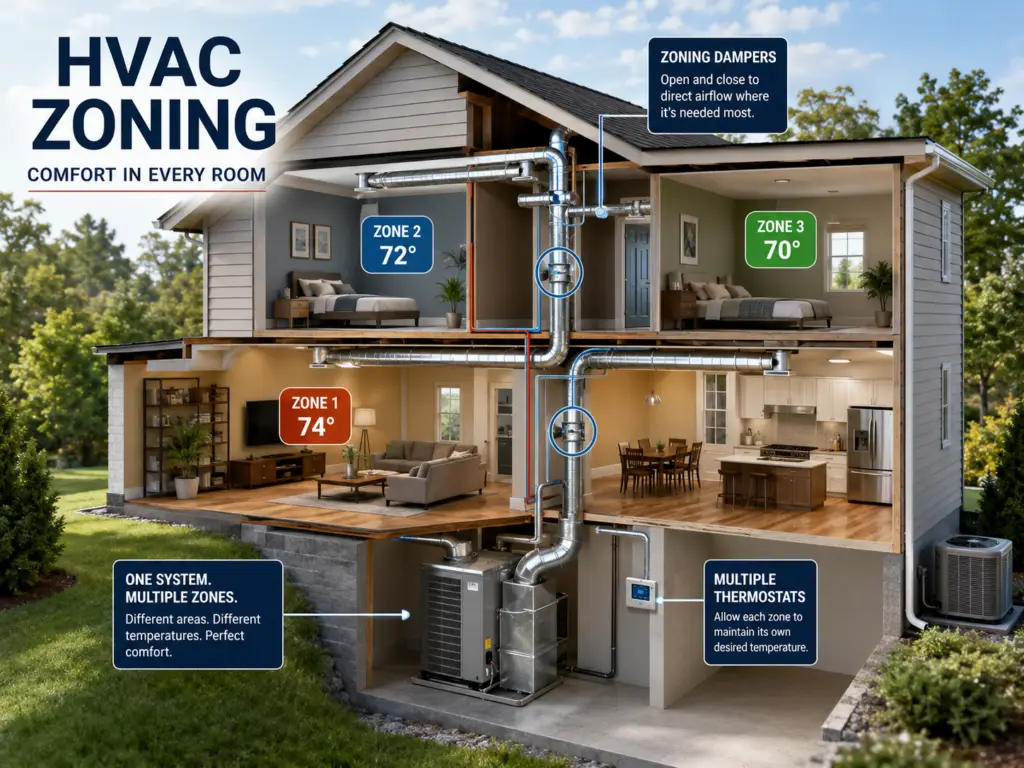
HVAC zoning divides your home into separate comfort areas, or “zones,” that can each maintain their own temperature—all while using a single heating and cooling system.
Instead of treating your entire house as one large space, zoning allows different areas to receive different amounts of conditioned air based on their needs.
For example:
- Your upstairs can stay cooler at night.
- Bedrooms can be adjusted independently from living areas.
- Rooms that receive more afternoon sunlight can receive additional cooling.
This helps create more even comfort throughout the home without constantly adjusting the thermostat.
How Do HVAC Dampers Work?
An HVAC damper is a device installed inside your ductwork that controls airflow to different parts of your home.
Think of dampers as traffic directors for your heating and cooling system.
When a zone calls for heating or cooling, the dampers open to send conditioned air where it’s needed and close in areas that don’t currently need as much airflow.
Working together with multiple thermostats and a zoning control panel, dampers help deliver comfort where you need it most.
Signs Your HVAC System May Have an Airflow or Zoning Issue
If you’re experiencing any of these problems, your home may benefit from an airflow evaluation:
- Upstairs is consistently warmer than downstairs.
- One room never seems to reach the desired temperature.
- Certain vents barely blow air.
- Your thermostat says one temperature, but your home feels very different.
- Some rooms feel drafty while others stay stuffy.
These symptoms don’t always mean you need a new HVAC system. Sometimes the issue lies with airflow, ductwork, or system design.
Should You Close Vents in Unused Rooms?
This is one of the most common HVAC myths.
In most homes, the answer is no.
Closing supply vents might seem like a simple way to force more air into other rooms, but it can actually:
- Reduce overall system efficiency
- Create unnecessary pressure inside your ductwork
- Put additional strain on your HVAC equipment
- Lead to uneven temperatures elsewhere in the home
Rather than closing vents, it’s better to identify the underlying reason a room isn’t staying comfortable.
What If My Home Can’t Support HVAC Zoning?
Not every home’s ductwork is designed for a traditional zoning system.
Older homes, remodeled homes, and houses with additions often have duct layouts that make zoning difficult—or simply not cost-effective.
In these situations, a ductless mini-split is often an excellent alternative.
Mini-splits provide:
- Independent temperature control
- Excellent energy efficiency
- Heating and cooling without modifying existing ductwork
- Comfort for additions, bonus rooms, garages, finished basements, and other hard-to-condition spaces
For many homeowners, a mini-split solves comfort problems that traditional zoning cannot.
The Best Solution Starts with the Right Diagnosis
No two homes are exactly alike.
The same symptom—like one hot bedroom—can have several different causes, including:
- Improper airflow
- Ductwork restrictions
- Poor system design
- Insulation issues
- An aging HVAC system
- Thermostat placement
- Lack of zoning
That’s why a professional evaluation is the best first step before investing in equipment or trying DIY fixes.
At A+ Derr, our comfort specialists inspect your system, explain what’s causing the issue, and recommend solutions that fit your home—not just a one-size-fits-all answer.
Ready for More Comfortable Living?
If you’re tired of dealing with hot upstairs bedrooms, cold bonus rooms, or uneven temperatures throughout your home, we’re here to help.
Whether your home could benefit from HVAC zoning, ductwork improvements, or a ductless mini-split, our team can help you find the right solution.
Schedule an HVAC evaluation with A+ Derr today and enjoy comfort in every room of your home.